
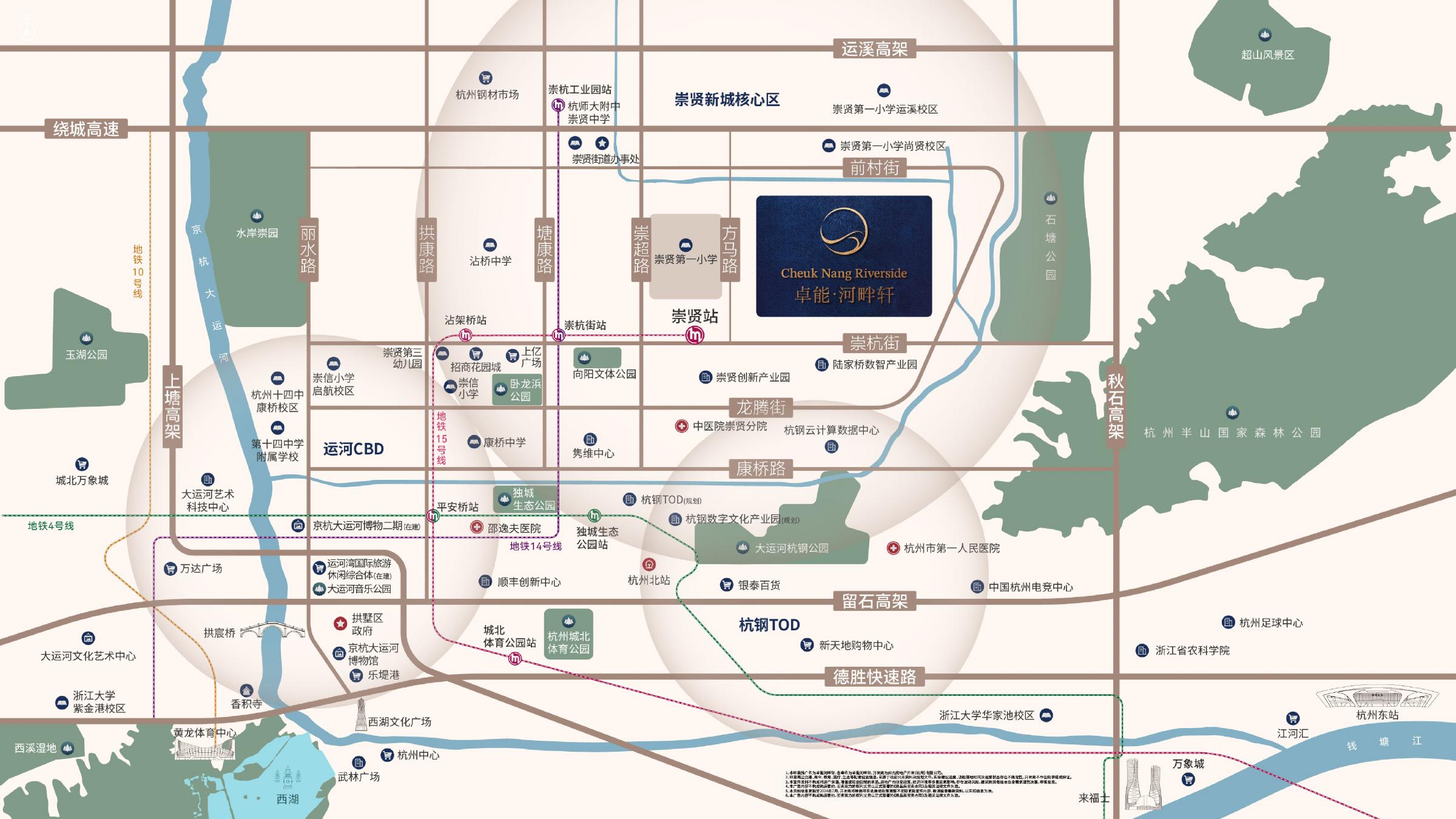
When looking at properties along Line 15, the most practical way is to compare the line progress, the project’s route to the station, and the family’s daily commute. Only after seeing these three things clearly can the site map truly become a reference for life. The public plan for the first phase of Line 15 starts at Yatai Road Station and ends at Chongxian Station. Cheuk Nang Riverside is located in LinpingChongxian. The official website displays about 65-138 sq m of unit types, actual project scenes and location information about a 400-meter straight line distance from related sites. It is suitable for people who want to buy properties along the line to arrange an on-site understanding.
Phase 1 of Line 15, what information does the official document confirm?
According to the environmental impact report issued by Hangzhou Metro Group, the first phase of Line 15 is a new line, starting from Yatai Road Station and ending at Chongxian Station. The total length of the line is about 41.02 kilometers, all underground lines, with a total of 30 stations, including 15 transfer stations, Shushan South Vehicle Base and Chongxian parking lot.
The public lines are mainly laid out along Shushan Road, Xianghu Road, Jinji Road, Mingxing Road, Yingfeng Road, Tongwen West Road, Sanxin Road, Jingfang Road, Huancheng East Road, Shaoxing Road, Dongjiao Road, Gongkang Road, Chonghang Street and other roads. It connects a very long north-south corridor, which does not mean that any two stations along the line are suitable for daily travel.
The Hangzhou government work report in 2025 stated that the fourth phase of the subway has been fully started; the Hangzhou subway procurement platform will still announce the procurement results of related projects for the first phase of Line 15 in 2026. Based on these public information, this article only uses the expression "under construction" and does not include the opening date that has not been confirmed by the latest official announcement.
The station name, entrances and exits, construction organization and project progress may be adjusted later. Before making a formal decision to buy a house, you should re-check the Hangzhou subway and government websites instead of citing self-media route maps.
The four most easily miscalculated periods when buying a house along the route
The real commute time is:
Walk from your home to the station entrance + wait for the train in the station + train operation + wait for transfer + walk out of the station to the company.
Promotional materials often only show the third paragraph, which happens to miss the most volatile part.
1. From the community gate to the future entrance and exit
Straight-line distance is only suitable for rough screening on the map. Actual walking may be affected by walls, rivers, railways, expressways, overpasses and entrance and exit directions. The site will be walked along the existing road, leaving the possibility of "future entrances and exits yet to be determined".
2. Entering the station and waiting for the bus
It takes time to get from the entrance to the platform in an underground station. Security checks, escalators and waiting times during rush hours also add to commutes. When calculating, leave at least 8-12 minutes of buffer for this section; this is a personal calculation assumption, not the official operating data of Line 15.
3. Transfer
In the official plan, there are 15 transfer stations among the 30 stations, but "interchangeable" does not mean zero-cost transfer. Those who need to change lines should make a separate note of walking within the station and waiting for the next train. It's often more important that your destination is close to a transfer station than one less stop on the route map.
4. The last mile on the company side
When a train reaches a certain area, it does not mean it reaches an office building. Industrial parks, hospitals, schools and office buildings may still be some distance away from the station entrance. Put the real company address into the route software, and do not use large-scale names such as "HangzhouEast" and "Qianjiang New City" to replace the destination.
Looking at the projects along Line 15, first ask how to get there now
When the subway has not yet been put into operation, the current traffic situation of the project is the real life in the next period of time. Check in order:
- How to connect to the nearest operating subway station, and whether the weekday and last-minute connections meet the demand;
- Whether self-driving must rely on a road prone to congestion, and whether there are alternative routes;
- Is it still acceptable to walk and transfer on rainy days or when traveling with children or the elderly?
- Will the ongoing construction have any periodic impact on roads, noise and daily travel?
Hangzhou The current operating service page of the official subway website lists Lines 1-10, Line 16 and Line 19. The current commute should be based on these existing lines, buses and roads, and Line 15 will be included in a separate column as a future scenario.
How to walk on the Chongxian section: put about 400 meters into the real life activity line
The northern end of the first phase of Line 15 reaches Chongxian. The public plan of the line is to enter Chongxian along Gongkang Road, Chonghang Street and other roads. For people who move more in the north of the city, north of Gongshu or Linping, this is a traffic change worthy of attention; for people who work at the other end of the city, complete routes and transfers still need to be calculated.
Cheuk Nang RiversideThe official website indicates "approximately 400 meters straight line distance". Do four things during an on-site inspection:
- Open the official project website and the official public information of Hangzhou subway to confirm whether they refer to the same proposed station;
- Time from the actual entrance and exit of the community along the walkable road, and do not cross unopened land or construction areas;
- When asking about future entrances and exits, only traceable government or construction unit documents will be accepted, and verbal directions will not be regarded as final;
- Save the "current connection plan" and "future hypothetical plan" separately to avoid confusion during sales communications.
When visiting, you can start from the actual entrance and exit of the park and walk through the roads, streets and daily walking routes to form your own location experience.
In addition to transportation, the house must pass at least three tests.
Family size and house type
In addition to convenient transportation, family-friendly space will make the living experience more complete. Taking the house type on the official website of Cheuk Nang Riverside as an example, one or two people can first compare one bedroom of about 65 sq m and two bedrooms of 67 sq m; a family of three focuses on the storage and daily circulation of three rooms of about 88 sq m; when improving the family, you can experience the public space and two-bathroom configuration of about 138 sq m, three bedrooms and two bathrooms.
This sequence of viewings can help different families quickly identify the key points, and then further compare based on the target floor, orientation and budget when visiting.
Current living facilities
Write down the five most frequently used places in daily life: food market or supermarket, community medical care, children’s activity space, express delivery point, and route home at night. Businesses under planning cannot be scored as if they have already opened.
Building and campus sites
When there are real-life conditions, you can focus on experiencing the building scale, lighting, waterfront environment, walking in the park and the route home from the underground garage to the residence. The official website of Cheuk Nang Riverside has displayed pictures of buildings, parks and waterfront environments. You can walk through the same location completely after making a reservation.
A reusable rating form along Line 15
Record each item on a scale of 0-5, and do not set the "Appreciation Potential" column:
| Project | weight | How to verify |
|---|---|---|
| Current door-to-door commute | 25% | Walk in person once on a working day |
| Walking and transferring in the future subway | 15% | Only use official solutions and retain uncertainty |
| House type adaptation | 20% | Check the clear space with furniture dimensions |
| Current living facilities | 15% | Walk on the ground, regardless of planned quantities |
| Total cost and cash flow | 15% | The total price, taxes, decoration, and reserve funds are calculated together. |
| On-site environment and property movement | 10% | Watch it once during the day and once at night |
In the future, the subway will only account for 15%, in order to prevent a planning diagram from overwhelming the houses that are actually used every day. Weights can be adjusted based on family circumstances, but comparisons must remain consistent within the same round.